


Six AI governance standards, one voice agent: what buyers should actually check
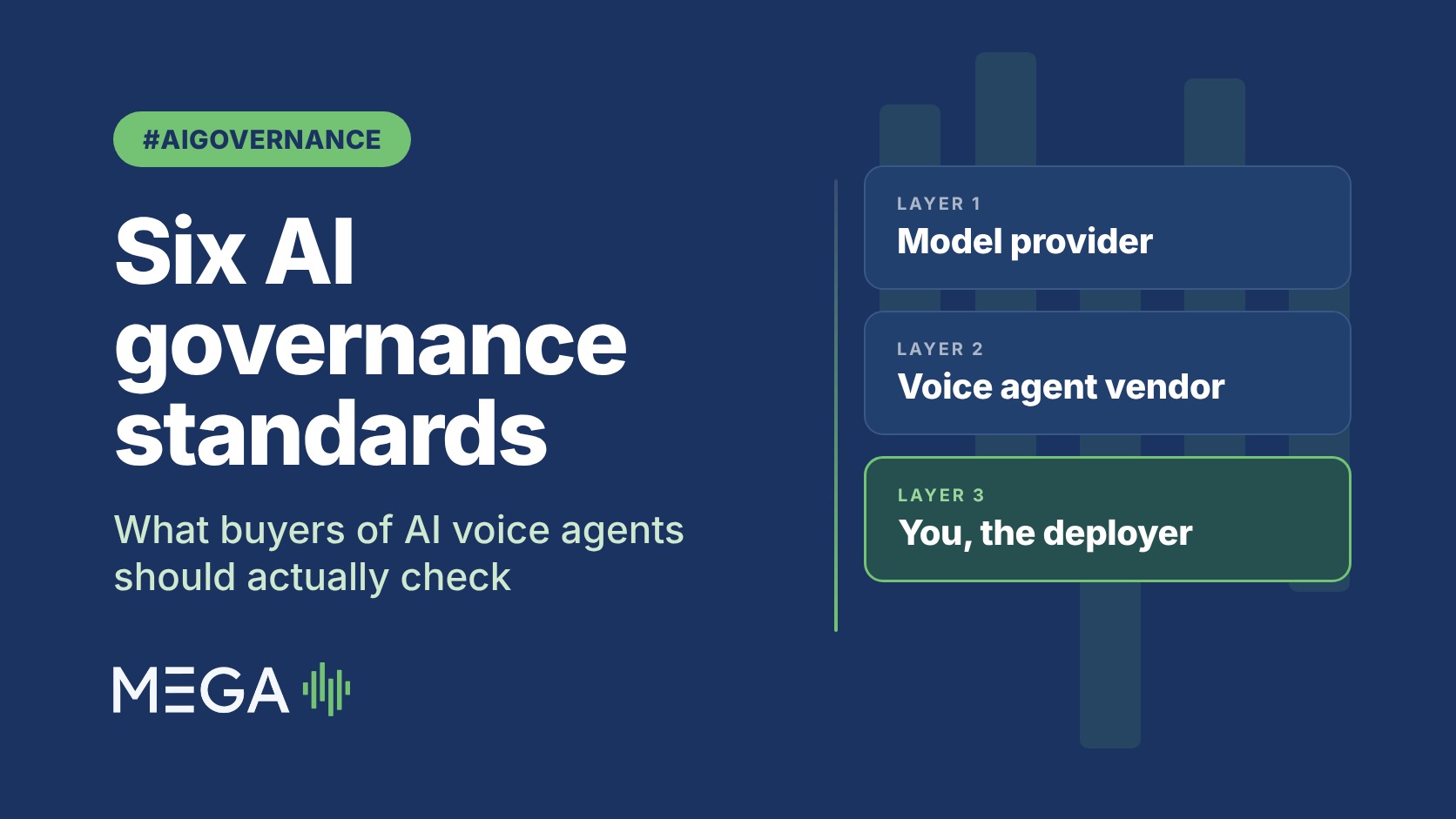


A useful infographic is doing the rounds: six AI governance standards every leader should know, with one question to ask about each. It is a good map. For anyone buying an AI voice agent, it answers the wrong question.
The buyer’s question is not which standards exist. It is which obligation sits with whom, and what evidence you demand before the first customer call goes live.
Seen that way, the six split quickly. Three are voluntary: ISO/IEC 27001, ISO/IEC 42001 and the NIST AI RMF. One binds only developers that train frontier models: California SB 53. One applies only to Canadian federally regulated financial institutions: OSFI E-23. That leaves one law, the EU AI Act, that binds most buyers directly when they deploy AI in the EU or their agent’s output is used there.
Voluntary does not mean irrelevant. Certificates are how you check a vendor without auditing them yourself, within the scope they cover. But you need to know which is which, and the rules most likely to get a collections firm fined are not on the list at all.
Who carries what: three layers
Every AI voice agent sits on a stack of three roles, and each standard lands on a different one. One company can hold more than one role.

- The model provider develops the language, speech-to-text and text-to-speech models underneath. California SB 53 lands here, and so do the EU AI Act’s rules for general-purpose AI models, where a model qualifies as one. Not every speech model does.
- The voice agent vendor builds the system your customers talk to. Under the EU AI Act it is usually the provider of that system. ISO/IEC 27001 and ISO/IEC 42001 certify how it is run, within the scope of the certificate.
- You are the deployer if you use the agent under your own authority. You own the customer, the conduct rules and the relationship with your regulator. Rebrand or materially change the system, and you can take on provider duties too.
Every layer has its own duties, and yours do not transfer. The vendor and the model provider keep their own obligations, and a vendor acting as your data processor has direct duties of its own. But if an agent mistreats a vulnerable customer, “our vendor is ISO certified” will not show your regulator that your controls worked. If you are an agency collecting for a bank or a utility, your client will add its own requirements to your contract, so you need the evidence twice over.
Your job as a buyer is to collect evidence from the layers above you, document who does what, and own the layer you sit in.
EU AI Act: the one that binds you now
If your agent is deployed in the EU, or its output is used there, four parts of the Act already shape what you buy. The high-risk rules, the part most people worry about, come later.
Disclosure is required. Since 2 August 2026, providers must design systems that talk to people so those people are told they are talking to an AI, at the latest on first interaction (European Commission). The exception for cases where this is obvious will rarely help a voice that sounds human. Ask the vendor where the disclosure sits in the call flow and how it survives configuration changes. On EU calls, it should not be something anyone can switch off.
Synthetic voice must be marked. Providers of systems that generate synthetic audio must also mark it in a machine-readable, detectable way. That is a separate duty from the spoken disclosure. Systems on the market before 2 August 2026 have until 2 December 2026; systems launched after that date had no grace period (Paul Weiss). Ask your vendor, and its speech provider, whether the duty applies, who carries it, and for test evidence that the marking survives the telephone network.
Some practices are banned outright, since February 2025. Two matter in collections (AI Act, Article 5). Article 5(1)(a) bans manipulative or deceptive techniques. Article 5(1)(b) bans AI that exploits a person’s vulnerability due to age, disability or a specific social or economic situation, materially distorting their behaviour in a way that causes, or is reasonably likely to cause, significant harm. Arrears alone do not meet that test, but collections is where its conditions meet most often. An agent tuned purely for promise-to-pay rates, with no guardrails on pressure, is a scenario you do not want to defend. Conduct well short of the ban can still breach consumer and collections rules. Ask what the agent is optimised for and what stops it from pushing.
Emotion recognition is a trap hidden in feature lists. Reading customers’ emotions from their voice is not caught by the workplace ban, while reading your own staff’s emotions is (Commission guidelines). That does not make it free. Voice-based emotion recognition is on the high-risk list, and people must be told when it is used on them. Inferring emotion from words alone falls outside the definition, but can still amount to profiling or reveal health data under the GDPR. So when a vendor sells “vulnerability detection”, ask what it analyses, what it infers and how that changes treatment.
The high-risk rules moved. The Digital Omnibus, Regulation (EU) 2026/1744, in force since 27 July 2026, pushed standalone high-risk systems to 2 December 2027 and product-embedded ones to 2 August 2028. Debt collection is not itself a high-risk category; the credit category covers assessing creditworthiness and credit scores. A collections agent moves closer if it assesses creditworthiness or affordability, or reads emotion from voice. Get the vendor’s classification in writing, with its reasoning, and test it against your own use.
ISO/IEC 27001 and 42001: what a certificate proves
Both are voluntary, certifiable management system standards. That is their value: an independent certification body has checked that the vendor runs a disciplined system within a defined scope, so you do not have to. It is also their limit. A certificate proves a system exists, not that a given call is secure, fair or lawful.
ISO/IEC 27001 covers information security. For a voice agent, the real question is scope. Check three things:
- The certified entity and scope cover the voice platform and the operations behind it, not just the head office. If hosting regions are not named, verify them separately.
- The certification body is itself accredited by a national body such as UKAS. Accreditation is not automatic.
- Every supplier that touches audio or data is mapped: telephony, speech-to-text, text-to-speech, the language model and hosting. A certificate that stops at the vendor’s own boundary says nothing about a speech provider in another region. Check those controls, contracts and transfer terms too.
Also ask where audio and transcripts are processed, whether they are used for training, and how long recordings are kept. Voice is personal data and, in some uses, biometric data. Customers in arrears also volunteer health information, which is special category data.
ISO/IEC 42001 is the AI management system standard: AI policies, risk and impact assessment, human oversight and monitoring. “Aligned with 42001” is a common claim, and alignment is not certification. Ask for the certificate and check its scope.
Then ask the question that matters most for voice: how are model changes controlled? Language and speech models are updated by their providers, sometimes with little notice. You want advance warning, regression tests against your own call flows, and a log of what changed and when.
NIST AI RMF, OSFI E-23 and SB 53: know when they apply
NIST AI RMF is a voluntary US framework built on four functions: Govern, Map, Measure and Manage. NIST does not certify against it, so “NIST aligned” on a vendor slide needs evidence behind it. Its real use is internal, as a structure for your own AI risk register. Version 1.0 from January 2023 is still current; NIST says a revision is under way (NIST).
OSFI E-23 applies to Canadian federally regulated financial institutions from 1 May 2027. It is risk-based and proportionate, covers AI and third-party models, and links to OSFI’s third-party risk guideline B-10. One detail matters for voice agents: OSFI declined a grace period for third-party model risk management, though institutions can set a controlled exceptions policy (OSFI). E-23 does not make a collection agency or a vendor an OSFI-regulated firm, but banks and insurers will pass its requirements down by contract. Agree change notices and validation support early, not in April 2027.
California SB 53 binds developers that train frontier models above 10²⁶ operations, with heavier duties for those over $500 million in annual revenue (Future of Privacy Forum). Using an existing model does not make a buyer or a voice vendor a frontier developer. Its practical value is the disclosure it forces higher up: large frontier developers must publish how they manage catastrophic risk. Ask your vendor which models sit under the agent, from which provider, hosted where. Then read that provider’s framework, knowing it covers frontier risk, not your collections deployment.
What the list leaves out
For a collections firm, the infographic misses the rules most likely to produce a fine or a complaint. None of them is AI-specific. Your vendor may carry some of them directly, as a data processor for example, but none of them leaves your desk. The list below is a selection, not a complete checklist.
- FCA Consumer Duty and CONC 7 (UK). For FCA-regulated debts, arrears handling, forbearance and the treatment of vulnerable customers apply whether a person or an agent is on the call. Not every debt is FCA-regulated.
- UK GDPR (UK). Article 22 was replaced by Articles 22A to 22D on 5 February 2026 (SI 2026/82). Significant decisions made solely by automation need safeguards, including meaningful human intervention. AI handling arrears data will usually need a DPIA.
- GDPR (EU). Article 22 still restricts solely automated decisions with significant effect. A DPIA is required where processing is likely to be high risk, which is common in collections.
- Ofcom persistent misuse rules (UK). Abandoned and silent call limits apply to AI dialling as much as to any dialler.
- TCPA (US). The FCC ruled in February 2024 that AI-generated voices are “artificial” voices, so outbound AI calls need prior express consent unless an exemption applies (FCC). The ruling does not reach a customer calling in to an AI agent.
- FDCPA and Regulation F (US). For third-party collectors of consumer debt, call-frequency presumptions, required disclosures and conduct rules apply to every call, human or AI. Check state law too.
- PCI DSS (all markets). An industry standard applied through card contracts. If the agent takes payments, the payment flow is in scope. Card verification codes must never end up in a recording or transcript.
One more point. Outside the EU, AI disclosure rules are patchier, but not absent. Utah, for example, requires disclosure when a consumer asks, and up front in high-risk interactions in regulated occupations (Utah Code 13-77-103). Decide per market, deliberately, and disclose by default.
Ten questions to put in your RFP
- Which models sit underneath the agent, from which providers, and where are they hosted?
- Can we see your current ISO/IEC 27001 and 42001 certificates, with the certified entity, scope and certification body?
- Which suppliers touch audio, transcripts or customer data, in which regions, and is any of it used for training?
- What is your written EU AI Act classification of this agent for our use, who holds which role, and what is the reasoning?
- Where in the call does AI disclosure happen, and how is it protected against configuration changes?
- Does any feature infer emotion or vulnerability, from which inputs, and how does that change how a customer is treated?
- What is the agent optimised for, and what controls cover forbearance, vulnerability, disputes and handover to a person?
- How are model updates announced, tested against our call flows and logged?
- Does the Article 50(2) audio marking duty apply to your system, who carries it, which deadline applies, and what shows the marking works over the phone?
- Can we run our own vulnerable-customer scenarios before go-live, and review samples of our own calls after it?
A vendor that answers all ten with documents rather than slides has earned a closer look. It has not earned your sign-off.
The test that matters
Standards tell you whether a vendor runs a disciplined system. They cannot tell you what the agent says to a frightened customer at six on a Friday evening. Only testing can.
Do not buy on curated demos. Script your own vulnerability, affordability, dispute and failed-transfer scenarios, and run them before go-live. After launch, review samples of your own calls, with the privacy controls that recorded calls about debt deserve.
Use the six standards to decide whom to trust. Use your own tests to check that the trust was earned.
Peter Hauge Jensen is CEO of MEGA.AI, which builds AI voice agents for regulated debt collection. MEGA.AI Limited holds ISO/IEC 27001 and ISO/IEC 42001 certification, so these are questions we expect to be asked.
Sources
- EUR-Lex: Regulation (EU) 2024/1689, the AI Act
- EUR-Lex: Regulation (EU) 2026/1744, the Digital Omnibus on AI
- European Commission: guidelines on the Article 50 transparency obligations
- European Commission: guidelines on prohibited AI practices
- Paul Weiss: EU finalises transparency rules for AI-generated content
- OSFI: Guideline E-23 Model Risk Management (2027), letter
- NIST: AI Risk Management Framework
- Future of Privacy Forum: California’s SB 53 explained
- legislation.gov.uk: SI 2026/82, Data (Use and Access) Act commencement
- FCC: Declaratory Ruling on AI-generated voices under the TCPA
- Utah Code 13-77-103: generative AI disclosure